
Our story
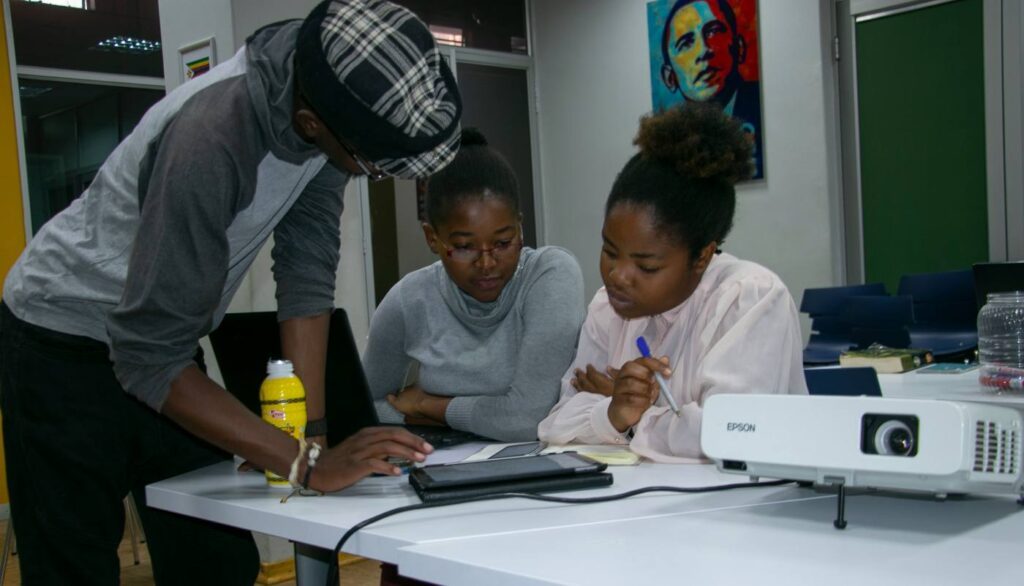
It started in a room at the Bulawayo Public Library.
Emzini means the house. Not the school, not the academy, not the bootcamp. That choice was deliberate, and it still governs how the place runs.
Each reported figure carries the outlet that published it and the date it was true. Club participation is counted separately and never folded into the headline. How we count.
How it began
2019 to now.
A room, a projector when it worked, and students who came back the following week.
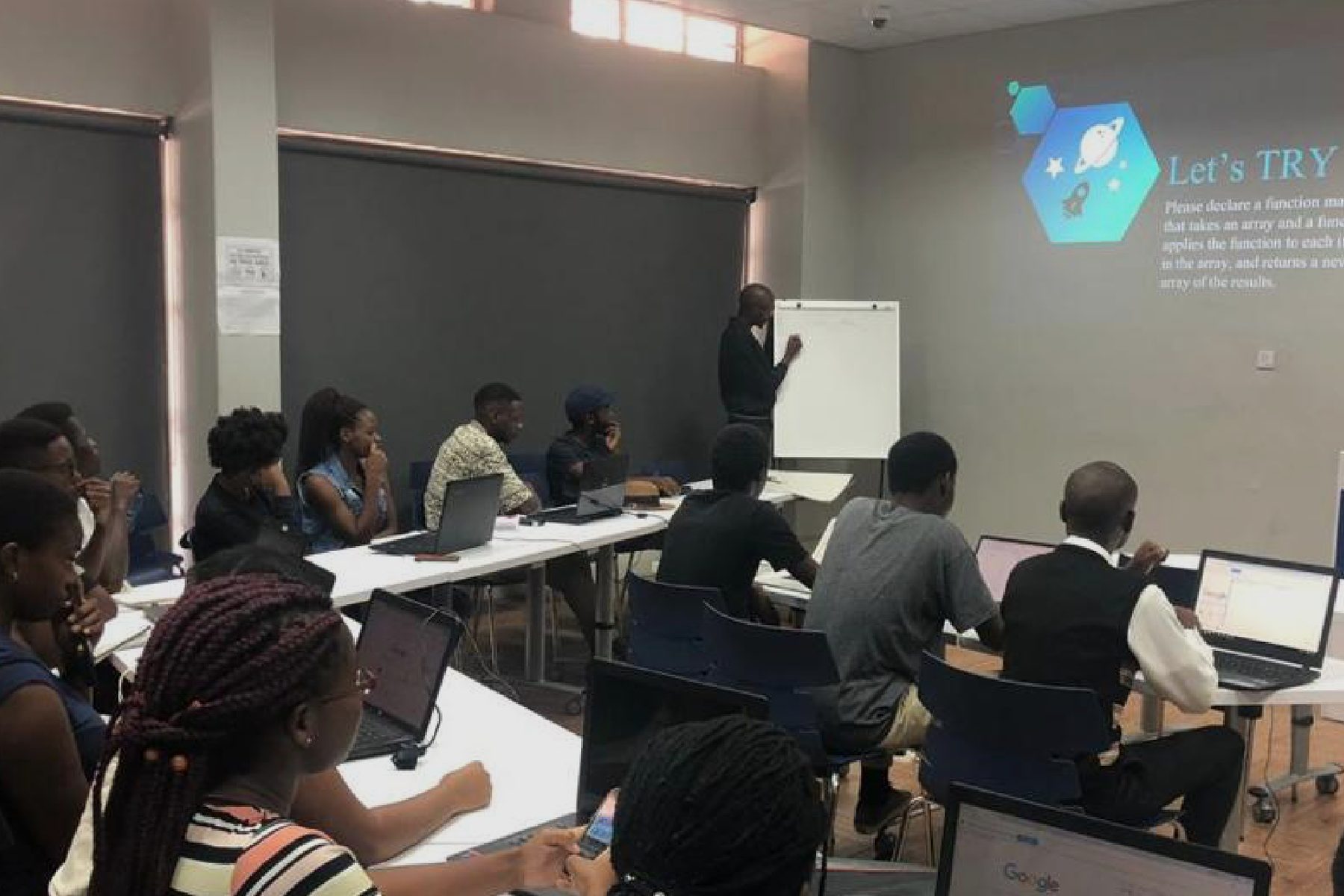
The first classes ran in Bulawayo, at the Public Library and later through the American Space at NUST. There was no platform, no curriculum repository and no grading system. There was a room and the people in it.
What that room taught us is the thing the organisation is now built around: the syllabus is not the hard part. Anyone can find a good syllabus. What is hard is the culture, the expectation that you will struggle and continue anyway, and the presence of somebody slightly further along who has already struggled with exactly the thing defeating you.
Going online was arithmetic rather than strategy. One room in Bulawayo holds thirty people, and there were more than thirty who wanted to learn. Scaling a room is easy; scaling the culture of a room is not, and that is where most online courses quietly fail. So we kept the mentorship and industrialised everything around it, which is how we ended up writing our own grading platform instead of buying one.
Where it ran
A borrowed room, a projector, and whoever turned up.
The Public Library first, then the American Space at NUST, which has since closed. Everything the organisation does now is an attempt to give that room more capacity than one room can have.
The founder
Eric Khumalo
Founder and head instructor
The syllabus is not the hard part. Anyone can find a good syllabus. What is hard is the culture, and somebody slightly further along who has already struggled with the thing defeating you.
Founded Emzini weCode in 2019 after a semester away from UC Berkeley, where he studied on a Mastercard Foundation scholarship. Taught at three high schools before that. The first classes ran in a room at the Bulawayo Public Library.
Mission
To teach computer science to a university standard, mentor the people who finish into work worth doing, and charge what each household can actually afford.
We started in Bulawayo. We have never restricted it to Bulawayo.
Three commitments, all testable. If the teaching is not rigorous, if graduates are not getting work, or if somebody able is turned away over money, we have failed at something specific.
Vision
A generation of African engineers who did not have to leave to become good, and who choose what to do next.
Most of ours are Zimbabwean because that is where we started, not because that is who we are for.
Some will build here and some will build elsewhere. The point is that it becomes a decision rather than the only door that opened.
What we stand for
Four, and each one costs us something. That is how you tell a value from a slogan.
Values.
- Rigour is respect
- We teach at a university standard and mark to it. Lowering the bar for students here would be condescension dressed as kindness. What it costs us: people drop out, and our completion rate is lower than it would be if we made the course easier.
- Nobody is turned away over money
- Fees scale from a tenth of the cost to the whole of it, and the assistance question sits inside the ordinary application so nobody has to ask separately. What it costs us: every cohort has a hard financial ceiling, and when we say a cohort is full it is full.
- Alumni are faculty
- The people who finish come back to teach the cohort behind them. It is the staffing model, not a nice sentiment. What it costs us: we train teachers every year and lose them to good jobs, which is also the point.
- Say only what we can show
- Every number we publish carries a source or a stated method, and where we cannot yet measure something we say so. What it costs us: our figures are smaller than the ones we could get away with.
Support and collaboration
Who has backed this.
Named, because an organisation with no named backers reads as unfunded.
- Big Ideas at UC Berkeley
- Early funding, won through Berkeley's student innovation contest.
- Davis Projects for Peace
- Project grant.
- Education Matters
- Collaboration on access to education in Zimbabwe.
- Mastercard Foundation
- Scholar support for the founder, and funding reaching us through Big Ideas.
- NUST American Space
- Hosted early in-person classes in Bulawayo.
Come in
The door is the same one we came through.
Whether you want to learn, to teach, to host a club or to fund one, it starts the same way.